
Choosing a business structure is one of those decisions that feels boring until it starts affecting your taxes, funding, ownership, paperwork, and personal risk.
A C Corporation can be a powerful structure if you want to build a company that can raise money, issue shares, add investors, and operate separately from you as the founder. At the same time, it is not the simplest option for every small business.
That is where many new entrepreneurs get stuck. They hear that a C Corp is “what real startups use,” but they also hear about double taxation, board meetings, bylaws, annual reports, and state fees.
So what is a C Corporation really, and should you form one?
This guide explains how a C Corp works, who it suits best, how it compares with an LLC and S Corp, and why using Bizee can make the formation process much easier if you decide this is the right structure for your business.
What Is a C Corporation?

A C Corporation, often called a C Corp, is a separate legal business entity formed under state law. Once created, the corporation exists apart from its owners.
The owners are called shareholders. The shareholders own stock in the company, while directors and officers manage the company’s major decisions and daily operations.
This separation is the core idea behind a corporation. The company can enter contracts, own assets, open bank accounts, hire employees, raise capital, and pay taxes in its own name.
For founders, that legal separation can be valuable. If the corporation is properly formed and maintained, shareholders are generally not personally responsible for business debts or lawsuits just because they own the company.
That is one of the main reasons entrepreneurs choose a C Corp when building a business with bigger growth plans.
How a C Corporation Works
A C Corp has a more formal structure than a sole proprietorship or a typical LLC.
It usually includes three main groups:
- Shareholders who own the company through stock.
- Directors who oversee big decisions and protect shareholder interests.
- Officers who run daily operations, such as the CEO, CFO, or secretary.
In a small corporation, the same person may play more than one role. For example, a solo founder may be the only shareholder, the only director, and the president of the company.
Even then, the structure still matters. The corporation should keep records, follow state rules, issue stock properly, maintain bylaws, and document major decisions.
This is where many beginners feel overwhelmed. Forming the corporation is only one step. Running it correctly is what keeps the structure useful.
Bizee helps reduce that early stress by handling the formation paperwork and guiding you through the setup process. Their entry-level formation package, commonly known from the Incfile days as the Silver plan and now shown as the $0 + state fee basic package, keeps the starting cost low while still giving you professional filing support.
C Corporation vs. Other Business Structures
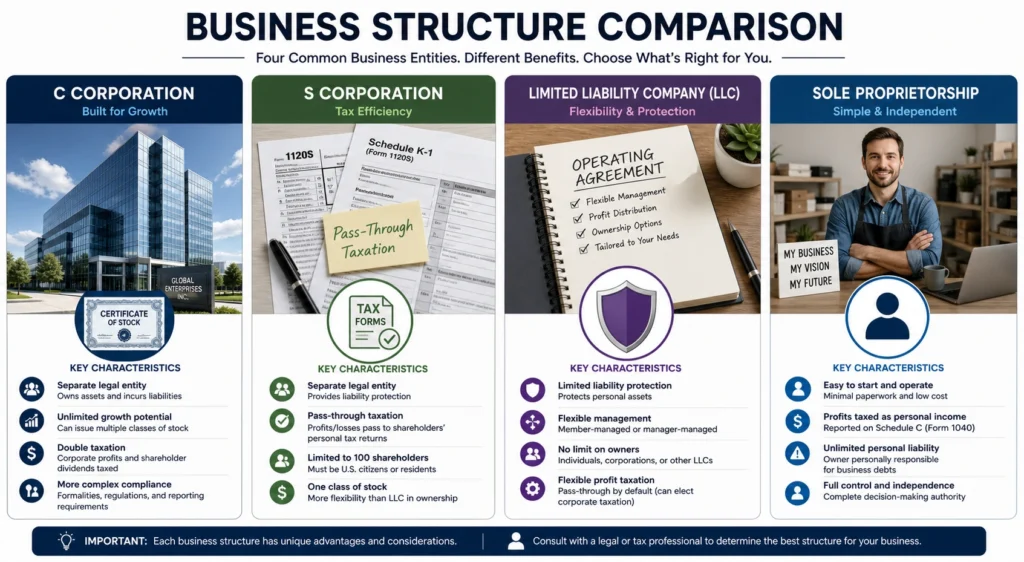
A C Corp is not the only way to structure a business. In fact, many small businesses start as LLCs because they are simpler to manage.
Still, a C Corp can be the better fit if you want investors, stock ownership, or a more traditional corporate structure.
| Feature | C Corporation | LLC | S Corporation | Sole Proprietorship |
|---|---|---|---|---|
| Legal protection | Strong personal liability protection | Strong personal liability protection | Strong personal liability protection | No separate liability shield |
| Tax treatment | Corporation pays its own income tax | Usually pass-through by default | Pass-through taxation | Owner reports income personally |
| Ownership | Shareholders own stock | Members own membership interests | Shareholders, with IRS limits | One owner |
| Investor-friendly | Very strong | Moderate | Limited | Weak |
| Paperwork | Highest | Moderate | High | Lowest |
| Best for | Startups, investors, scalable companies | Small businesses, agencies, online businesses | Tax planning for eligible small corporations | Simple low-risk solo work |
Why Entrepreneurs Choose a C Corporation

1. Personal Liability Protection
A C Corp creates a legal wall between the company and its shareholders. This can help protect personal assets if the business faces lawsuits, debts, or contract disputes.
That protection is not automatic in every situation. Owners still need to avoid fraud, keep business and personal money separate, and follow corporate rules.
But compared with operating as a sole proprietor, a C Corp gives you a much stronger legal foundation.
2. Easier to Raise Investment
If your plan is to raise money from investors, a C Corp is often the preferred structure.
Investors usually like corporations because stock ownership is familiar, transferable, and easier to structure. Venture capital firms often expect a corporation, especially if the company may raise multiple rounds of funding.
A C Corp can also issue different classes of stock, such as common stock for founders and preferred stock for investors. That flexibility can be difficult or less attractive with other structures.
If you are building a local service business, this may not matter much. But if you are building a tech startup, SaaS company, marketplace, or brand that could bring in outside capital, it matters a lot.
3. Unlimited Shareholders
C Corporations can generally have unlimited shareholders. This makes them more flexible for companies that want to grow, bring in investors, offer employee equity, or eventually go public.
An S Corporation has shareholder limits and ownership restrictions. A C Corp does not have the same basic limitations, which is why larger companies commonly use this structure.
4. Stronger Business Credibility
A corporation can make your business look more established.
That can help when opening business bank accounts, applying for financing, working with suppliers, signing larger contracts, or presenting your company to investors.
A C Corp also gives your business a formal identity. You are not just operating under your personal name. You are building a separate company with its own legal standing.
The Tax Side of a C Corporation
C Corp taxation is one of the biggest things to understand before choosing this structure.
A C Corporation pays taxes separately from its owners. The company files its own corporate tax return and reports its own income, deductions, gains, losses, and tax liability.
If the corporation later distributes profits to shareholders as dividends, shareholders may also pay taxes on those dividends personally. This is what people usually mean by double taxation.
That sounds like a disadvantage, and for many small businesses it can be. An LLC or S Corp may be more tax-efficient for owners who simply want to take profits out of the business.
But a C Corp can still make sense when profits are being reinvested, outside investors are involved, or the company’s growth plan depends on issuing shares.
The right answer depends on your goals, income, and tax situation. A good tax professional can help you decide whether the C Corp structure supports your long-term plan.
Hidden Realities Beginners Often Miss About C Corporations
A C Corporation can look impressive from the outside. It gives you stock, investors, directors, officers, and a formal company structure.
But that structure also comes with responsibilities. If you ignore them, the corporation can become messy, expensive, or harder to manage than expected.
Annual Reports and State Fees Can Add Up
Most states require corporations to file annual or periodic reports. These reports keep your company information updated with the state.
Depending on your state, you may also need to pay franchise taxes, renewal fees, business license fees, or other state-level charges. Some states are affordable. Others can be more expensive.
This is why you should never look only at the formation fee. The real cost of a C Corp includes both the startup filing and the ongoing compliance obligations.
Bizee helps here by showing state filing costs during setup and offering compliance tools that help you track key deadlines. That can save you from missing a report simply because you did not know it was due.
Corporate Formalities Are Not Optional
A C Corporation should be treated like a real company, even if you are the only founder.
That means you may need to:
- Adopt corporate bylaws
- Appoint directors
- Issue stock
- Hold initial meetings
- Record major decisions
- Keep corporate records
- File required state reports
- Maintain a registered agent
These steps may sound formal, but they protect the structure you created. If you form a corporation and then run it like a personal side project, you weaken the value of having a corporation in the first place.
Double Taxation Can Surprise New Owners
Many beginners hear “corporation” and assume it is automatically better. That is not always true.
A C Corp can face double taxation when profits are taxed at the corporate level and then taxed again when distributed as dividends to shareholders.
This does not mean you should avoid a C Corp completely. It means you should choose it for the right reasons.
If you want investor funding, stock ownership, employee equity, or long-term scalability, the C Corp structure can make sense. If you simply want to run a one-person service business and take profits home, an LLC may be easier.
Investors May Prefer a C Corp, But Banks Still Want Clean Records
Forming a C Corp can make your business look more professional, but it does not replace financial discipline.
You still need clean bookkeeping, a business bank account, proper contracts, and accurate tax filings. Investors, lenders, and partners will care about how the company is managed, not just how it was formed.
A corporation gives you a stronger container. You still have to run the business properly inside that container.
Step-by-Step Guide to Forming a C Corporation
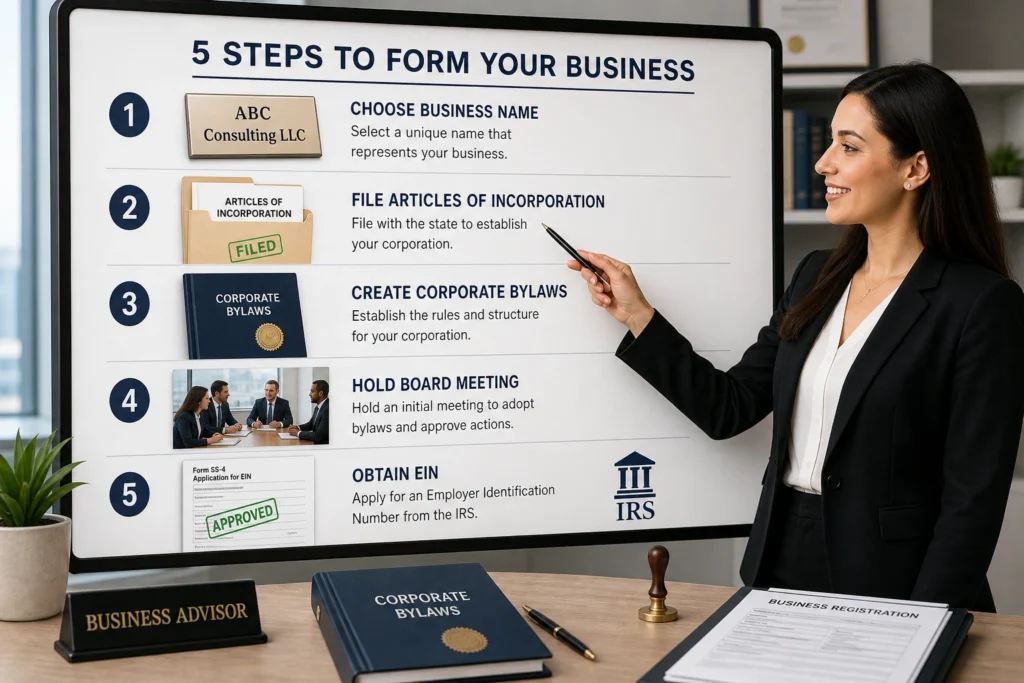
Step 1: Decide Whether a C Corp Fits Your Goal
Before filing anything, be honest about your business model.
A C Corp may be a strong fit if you plan to raise outside investment, issue stock, hire employees with equity, build a scalable startup, or create a company that could eventually be acquired.
It may not be the best first choice if you are a solo freelancer, local consultant, small agency, or side-hustle owner who wants the simplest possible setup. In those cases, an LLC may be easier and more flexible.
The goal is not to choose the structure that sounds biggest. The goal is to choose the structure that supports how your business will actually operate.
Step 2: Choose Your State of Formation
Many founders form their corporation in their home state. This keeps things simple if that is where they operate.
Some startups choose Delaware because it has a business-friendly corporate law system and is widely recognized by investors. But forming in Delaware can create extra registration and reporting requirements if you actually operate in another state.
For example, if you live and operate in Texas but form a Delaware corporation, you may still need to register as a foreign corporation in Texas. That means more paperwork and possible extra fees.
Bizee can help you compare state filing requirements and start the formation process without forcing you to figure out every state website on your own.
Step 3: Pick a Strong Business Name
Your corporation name must usually be unique in your state. It may also need to include a corporate ending such as “Corporation,” “Corp.,” “Company,” or “Inc.”
A good name should be clear, professional, and flexible. Avoid choosing something too narrow if you plan to expand into new products or services later.
Bizee’s formation process helps check name availability, which reduces the risk of filing under a name your state will reject.
Step 4: Appoint a Registered Agent
A registered agent receives official legal and state documents for your corporation. Most states require every corporation to have one.
You can sometimes act as your own registered agent, but that can create privacy and availability issues. Your address may become public, and you need to be available during business hours to receive documents.
Bizee includes a free first year of registered agent service when you form through them. For new founders, that is a practical benefit because it removes one more thing from your setup checklist.
Step 5: File Articles of Incorporation
To officially create a C Corporation, you file Articles of Incorporation with the state.
This document usually includes your corporation name, registered agent details, business address, share information, and incorporator details. Requirements vary by state.
You can file directly with the state, but mistakes can delay approval. Bizee prepares and submits the filing for you, which makes the process easier for first-time founders.
Their $0 + state fee Silver-style plan is especially useful if you want affordable formation help without paying a large service fee upfront.
Step 6: Create Bylaws and Issue Stock
After formation, your corporation needs internal rules. These are called bylaws.
Bylaws explain how the corporation will be managed, how directors are chosen, how meetings are handled, and how major decisions are approved.
You should also issue stock to the initial shareholders. This step matters because ownership in a corporation is based on shares.
If you skip this part, you may create confusion later when adding co-founders, investors, or employees.
Step 7: Get an EIN and Open a Business Bank Account
Your corporation will usually need an EIN from the IRS. This is like a tax ID number for the company.
You will need it to open a business bank account, hire employees, file taxes, and handle payroll.
Once your EIN is ready, open a separate business bank account. Do not mix personal and corporate money. Keeping finances separate helps protect the legal separation between you and the corporation.
Why Bizee Is a Smart Shortcut for Forming a C Corporation

A C Corporation can be powerful, but the setup has more moving parts than a basic sole proprietorship.
You need to choose the right state, prepare formation documents, appoint a registered agent, understand compliance duties, and keep your records organized.
That is why Bizee is a strong choice for new founders who want a cleaner, less stressful path.
Bizee helps handle the formation paperwork, provides registered agent service for the first year, and gives compliance reminders so you are not relying on memory for important deadlines.
The biggest attraction is the $0 + state fee entry plan. You still pay the required state filing fee, but Bizee does not charge a separate service fee for the basic formation package.
For a startup founder, small business owner, or online entrepreneur trying to stay lean, that is a real advantage. You get professional filing support without burning cash before the business even starts.
FAQs About C Corporations
What is a C Corporation in simple terms?
A C Corporation is a separate legal business entity owned by shareholders. It can own assets, sign contracts, issue stock, raise investment, and pay taxes separately from its owners.
Is a C Corporation good for small business owners?
It can be, but only in the right situation. A C Corp is usually better for businesses that want investors, stock ownership, or major growth. For simpler small businesses, an LLC may be easier to manage.
What is the main disadvantage of a C Corporation?
The biggest disadvantage is complexity. C Corps have more paperwork, formalities, tax filings, and compliance requirements. They can also face double taxation when profits are distributed as dividends.
Can one person own a C Corporation?
Yes. A single person can own a C Corporation and serve as shareholder, director, and officer, depending on state rules. Even then, the corporation should still follow proper recordkeeping and compliance steps.
How much does it cost to form a C Corporation with Bizee?
Bizee’s basic formation plan starts at $0 plus your state filing fee. Your total cost depends on the state where you form, because each state sets its own filing fee.
Final Thoughts and Next Steps
A C Corporation is not the easiest business structure, but it can be the right one if you are building something with serious growth potential.
If you want to raise capital, issue shares, bring in investors, offer equity, or create a company that can scale beyond one owner, a C Corp gives you the structure to do that.
At the same time, you should respect the paperwork. A corporation needs proper filing, records, compliance, and financial separation.
Bizee makes that first step much easier. With its $0 + state fee formation plan, first-year registered agent service, and compliance support, you can form your corporation without getting buried in state forms and confusing requirements.
If a C Corporation matches your business goals, do not let paperwork slow you down. Start with Bizee, get the structure in place, and build your company on a foundation that is ready for growth.