
Choosing between an S Corporation and an LLC can feel like a tax puzzle you did not ask for.
You want liability protection. You want to look professional. You want to avoid overpaying taxes. At the same time, you do not want to bury yourself in forms, payroll rules, state deadlines, and confusing IRS paperwork before your business even gets moving.
That is why the S Corporation vs. LLC decision matters.
An LLC gives you a flexible legal structure with personal liability protection. An S Corporation is usually not a separate business structure by itself. It is a tax election that certain LLCs and corporations can choose if they qualify.
That difference is where many beginners get confused.
This guide breaks down how LLCs and S Corps work, where they overlap, where they differ, and when each option makes sense. You will also see why Bizee is one of the easiest ways to start with an LLC and keep the door open for S Corp tax treatment later.
S Corporation vs. LLC: Quick Comparison Table
| Feature | LLC | S Corporation |
|---|---|---|
| What it is | A legal business entity | A federal tax election |
| Liability protection | Yes, if properly maintained | Yes, if attached to an LLC or corporation |
| Tax treatment | Pass-through by default | Pass-through with potential payroll tax savings |
| Ownership rules | Flexible | Strict IRS eligibility rules |
| Number of owners | Usually flexible | Limited to 100 shareholders |
| Owner type | Individuals, businesses, foreign owners may be allowed depending on state rules | Usually U.S. citizens or resident individuals only |
| Payroll requirement | Not always required for owner pay | Owner-employees must take reasonable salary |
| Paperwork level | Moderate | Higher |
| Best for | New businesses, freelancers, online brands, agencies, local businesses | Profitable businesses that can justify payroll and tax filing costs |
What Is an LLC?

An LLC, or Limited Liability Company, is a legal business entity formed at the state level. It separates the business from the owner, which can help protect personal assets if the business faces debts, lawsuits, or contract disputes.
For many small business owners, an LLC is the most practical starting point.
It is simpler than a corporation, easier to manage, and flexible enough for many types of businesses. A single person can own an LLC, or multiple people can share ownership as members.
An LLC can be used for:
- Freelancing
- Consulting
- eCommerce
- Affiliate marketing
- Local services
- Real estate
- Digital products
- Agencies
- Coaching
- Online publishing
The main benefit is that an LLC gives your business a formal legal identity without forcing you into heavy corporate formalities from day one.
How LLC Taxes Work
By default, a single-member LLC is usually taxed like a sole proprietorship for federal tax purposes. The owner reports business income and expenses on their personal tax return.
A multi-member LLC is usually taxed like a partnership by default. The LLC files an informational return, and profits or losses pass through to the members.
That pass-through treatment is one reason LLCs are popular. The business usually does not pay federal income tax separately at the entity level by default. The income passes to the owners.
But an LLC also has tax flexibility. If the business qualifies, the owner may elect to have the LLC taxed as an S Corporation.
That is where the comparison gets interesting.
What Is an S Corporation?
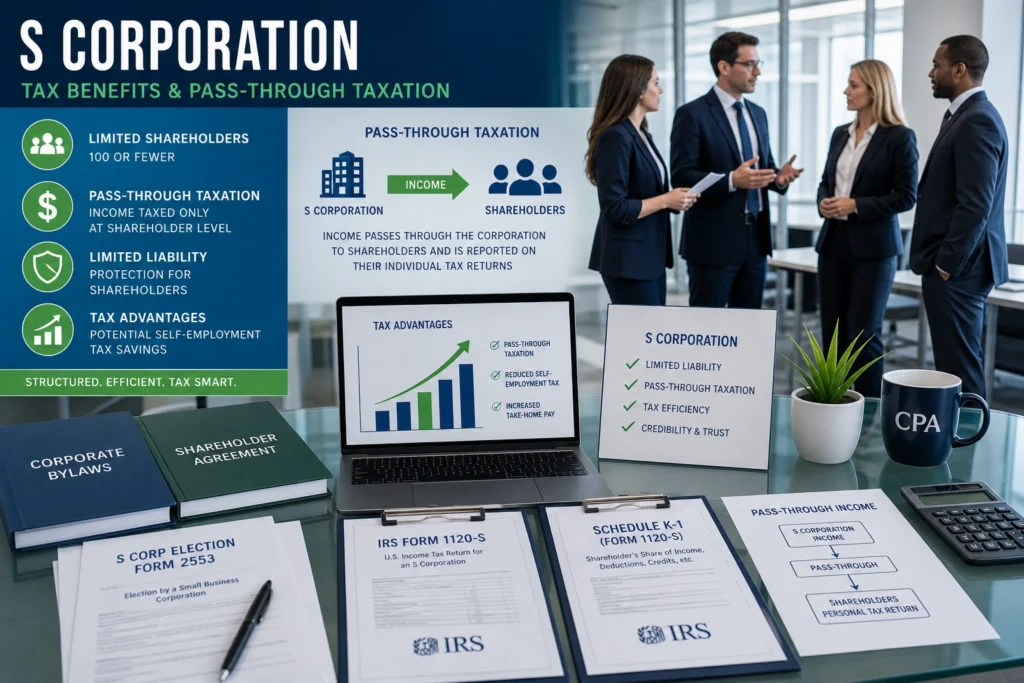
An S Corporation is a tax classification created through the IRS. It allows a qualifying business to pass income, losses, deductions, and credits through to the owners while potentially reducing some self-employment tax exposure.
A key point: an S Corp is not usually the first thing you form with the state.
You typically form an LLC or corporation first. Then, if the business qualifies, you file an S Corp election with the IRS.
This means many business owners do not choose between “forming an LLC” and “forming an S Corp” in a simple either-or way. A common path is:
- Form an LLC.
- Get an EIN.
- Open a business bank account.
- File Form 2553 with the IRS if S Corp taxation makes sense.
- Run payroll and follow S Corp rules.
This is why Bizee can be a smart starting point. You can form your LLC through Bizee for $0 plus your state fee, get help with the paperwork, and then explore S Corp election when the business has enough profit to justify it.
S Corporation vs. LLC: The Main Differences
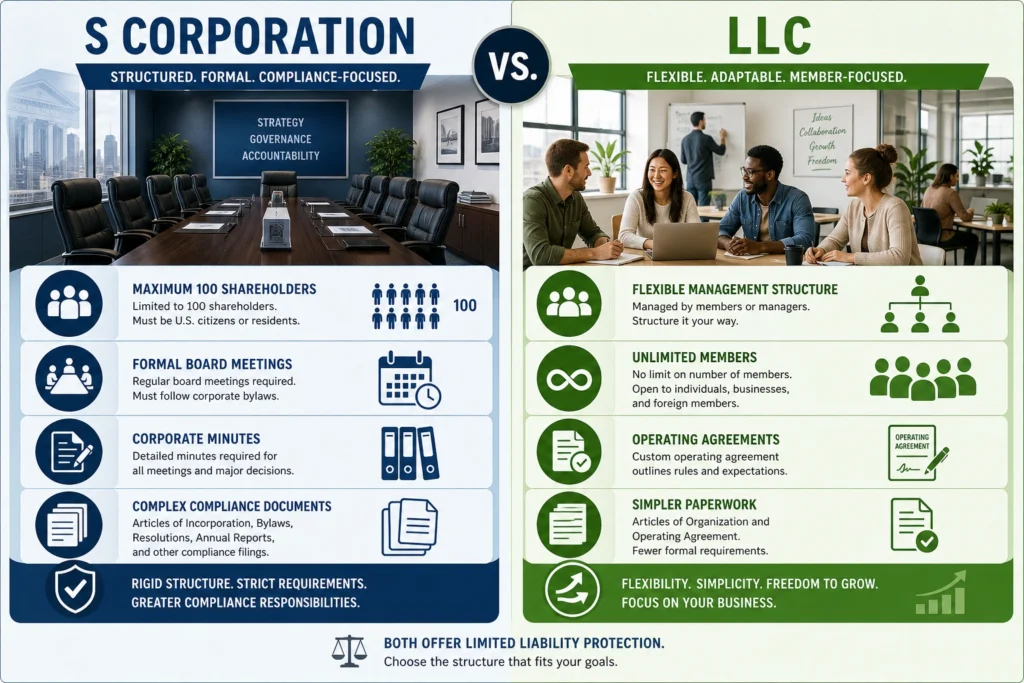
1. Legal Structure
An LLC is a legal entity. You create it by filing formation documents with your state.
An S Corp is a tax election. It tells the IRS how your qualifying business wants to be taxed.
This difference matters because an LLC gives you the business structure, while S Corp status changes the tax treatment.
For example, “Sharma Digital LLC” can be legally organized as an LLC while being taxed as an S Corporation by the IRS. To clients and banks, it is still an LLC. For federal tax purposes, it may be treated as an S Corp.
2. Liability Protection
Both LLCs and S Corps can offer liability protection when set up and maintained correctly.
With an LLC, the business is separate from the owner. If the LLC faces a business lawsuit or debt, the owner’s personal assets are generally not automatically at risk.
With an S Corp, liability protection depends on the underlying entity. If your LLC elects S Corp taxation, your LLC still provides the legal shield. The S Corp election mainly affects taxes.
To preserve that protection, you need to keep clean records, avoid mixing personal and business money, use proper contracts, and operate the business professionally.
3. Taxes
Taxes are the biggest reason people compare S Corporations and LLCs.
A regular LLC is simple. Business profit usually passes through to the owner. For a single-member LLC, the owner may pay income tax and self-employment tax on business profit.
An S Corp can change how owner income is handled. If you actively work in the business, you usually pay yourself a reasonable salary through payroll. Extra profit may be taken as distributions, which may not be subject to self-employment tax in the same way.
That can create tax savings for some profitable businesses.
But it is not automatic money in your pocket. S Corp taxation adds payroll, tax filings, bookkeeping discipline, and stricter owner compensation rules.
If your business only earns a small profit, the savings may not outweigh the extra cost and admin work.
4. Ownership Flexibility
LLCs are flexible. Depending on state law and your operating agreement, an LLC can often have different ownership structures, profit-sharing arrangements, and member types.
S Corps are stricter. They must meet IRS eligibility rules. In general, they are limited to a certain number of shareholders, cannot have certain types of owners, and can only have one class of stock.
This makes an LLC easier for many small businesses, especially if you have foreign owners, business entity owners, or custom profit-sharing plans.
An S Corp can still be great for the right business, but the rules are less flexible.
5. Paperwork and Administration
An LLC is usually easier to run. You may need an operating agreement, annual report, registered agent, state filings, and clean financial records.
An S Corp adds more layers.
You may need payroll software, payroll tax filings, reasonable salary documentation, separate tax returns, shareholder records, and stricter accounting.
That does not mean you should avoid S Corp taxation. It means you should choose it when the savings and structure justify the extra work.
Hidden Realities Beginners Often Miss
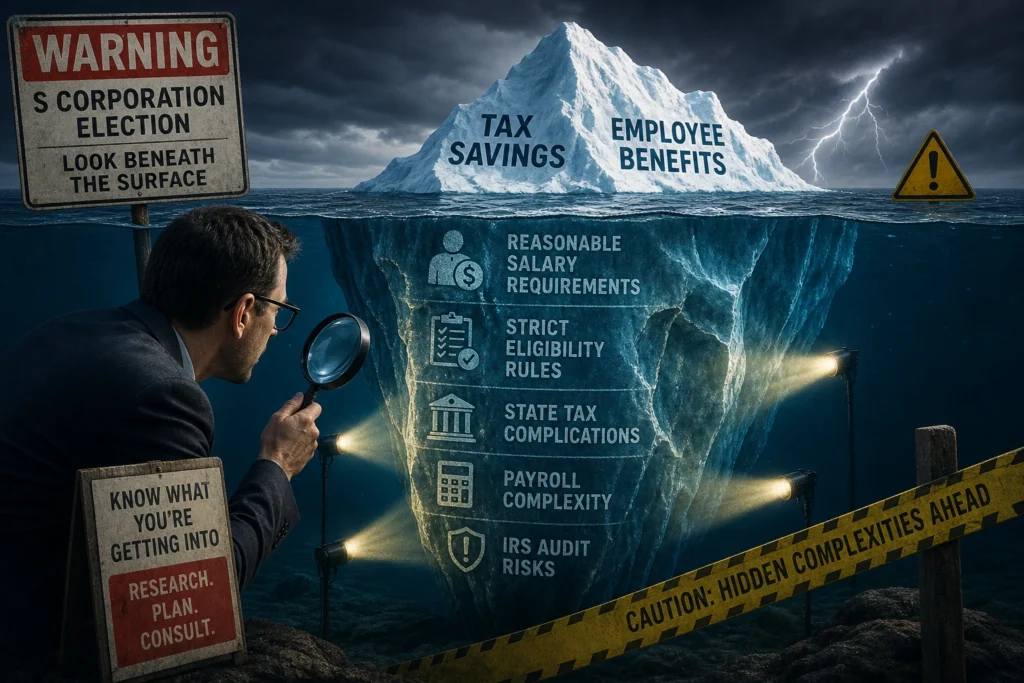
The LLC vs. S Corp debate usually gets reduced to one question: “Which one saves more tax?”
That is too simple. Taxes matter, but they are only one part of the decision. The better question is whether your business is ready for the extra structure that comes with S Corp taxation.
S Corp Savings Are Not Automatic
An S Corp can reduce self-employment tax for some profitable business owners, but it does not work like a loophole.
If you work in the business, you generally need to pay yourself a reasonable salary through payroll. Only after that can extra profit potentially be taken as distributions.
That means you may need payroll software, payroll tax filings, bookkeeping support, and a separate business tax return. Those costs can eat into the savings if your profit is still low.
For a new business, a regular LLC is often the cleaner starting point. Once the business earns steady profit, you can review the S Corp election with a tax professional.
You Still Need State Compliance
Whether you choose a regular LLC or an LLC taxed as an S Corp, state rules still apply.
Most LLCs need a registered agent. Many states require annual reports, renewal fees, franchise taxes, business licenses, or information updates.
This is where beginners get caught off guard. They form the LLC, celebrate the approval, and then forget about the next deadline.
Bizee helps reduce that risk by handling the formation filing and offering compliance tracking tools. That support can be a real stress reliever if you are already busy building the business.
Payroll Changes the Way You Pay Yourself
With a regular single-member LLC, taking money from the business is usually simpler. You can take owner draws, track income and expenses, and report profit on your tax return.
With S Corp taxation, things become more formal. If you actively work in the business, you generally pay yourself as an employee through payroll.
That means salary, payroll taxes, filings, and records. You cannot simply take all profit as distributions and call it tax planning.
Ownership Rules Can Limit Flexibility
An LLC is flexible with ownership. You can often design your operating agreement around different member roles, profit splits, and management rights.
An S Corp is stricter. It has IRS eligibility rules, shareholder restrictions, and limits on ownership structure.
If you have foreign owners, business entity owners, or investors who want flexible profit arrangements, an S Corp may not be the right fit.
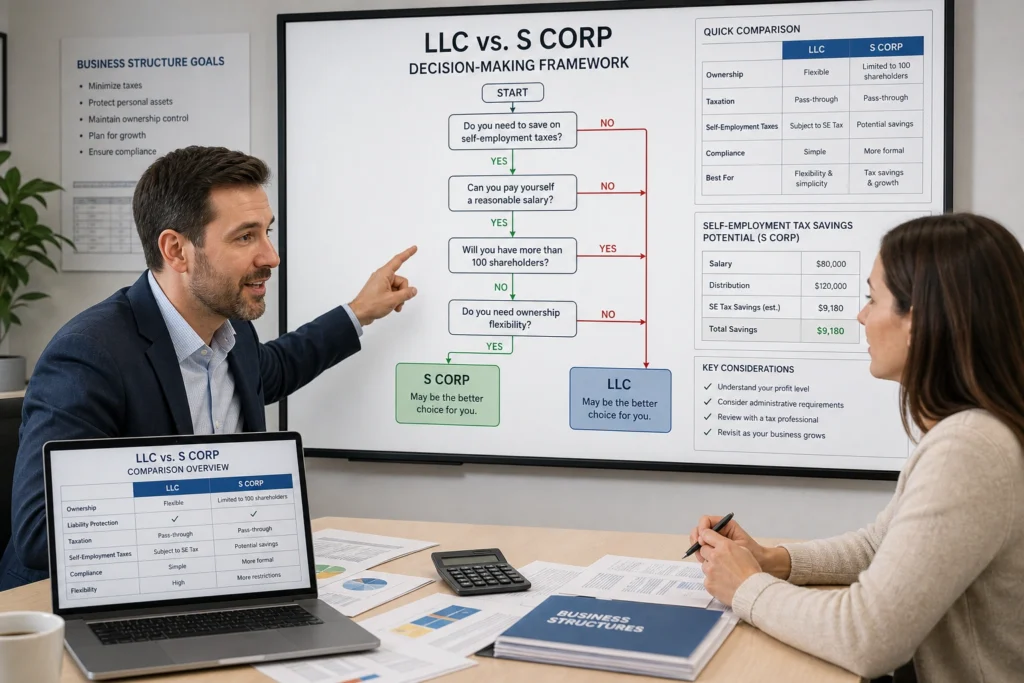
Step-by-Step Guide: How to Choose Between an LLC and S Corp
Step 1: Start With the Legal Entity
For most small business owners, the first practical move is to form an LLC.
The LLC gives you legal separation, personal liability protection, and a professional business identity. You do not have to elect S Corp taxation immediately.
This is why Bizee works so well as the starting point. You can form your LLC through Bizee for $0 plus your state filing fee, get the paperwork handled, and avoid trying to decode your state’s filing system on your own.
Step 2: Estimate Your Profit
S Corp taxation usually makes more sense when the business has consistent profit after expenses.
If your business is still new, unpredictable, or barely profitable, a regular LLC may be simpler and cheaper to maintain.
Once your profit becomes steady, the S Corp conversation becomes more serious. At that stage, compare your potential tax savings against payroll, accounting, and tax filing costs.
Step 3: Think About How You Want to Pay Yourself
If you want the simplest owner payment setup, a regular LLC is easier.
If you are comfortable running payroll and paying yourself a reasonable salary, S Corp taxation may become attractive.
The key is discipline. An S Corp is not just a tax label. It changes how money moves from the business to you.
Step 4: Check Ownership Plans
Ask yourself who will own the business now and later.
If it is just you, or you and a few eligible U.S. owners, an S Corp may work if the tax math makes sense.
If you want complex investors, foreign members, business entity owners, or custom profit-sharing terms, a standard LLC may give you more room.
Step 5: Form the LLC Correctly
To form an LLC, you usually need to choose a business name, appoint a registered agent, file Articles of Organization, and create an operating agreement.
You can do this manually through your state, but mistakes can slow you down.
Bizee simplifies the process. Their $0 + state fee formation package helps you start affordably, and the included first year of registered agent service adds strong value for new owners.
Step 6: Review S Corp Election Later
After your LLC is formed and earning consistent profit, speak with a tax professional about S Corp election.
If it makes sense, you can file the required IRS election and adjust your payroll and tax setup.
This path gives you flexibility. You are not forcing a more complex tax structure too early, but you are building on a legal entity that can support it later.
Why Bizee Is a Smart Shortcut for This Decision
Many entrepreneurs delay forming a business because they feel stuck between legal terms, tax rules, and state forms.
Bizee removes much of that friction.
Instead of spending hours comparing state filing pages, registered agent rules, and document requirements, you can answer guided questions and let Bizee prepare and submit the paperwork.
The best part is the price point. Bizee’s entry formation plan starts at $0 plus state fees, which makes it one of the most beginner-friendly ways to form an LLC.
For a first-time founder, that matters. You get a real business entity without paying a large service fee upfront.
Bizee also helps with registered agent service and compliance reminders, which are two areas new owners often overlook. That makes it more than a filing tool. It gives you a cleaner way to start and stay organized.
If you are unsure whether to elect S Corp taxation right away, start with the LLC. Bizee makes that step affordable, simple, and less stressful.
FAQs About S Corporation vs. LLC
Is an S Corp better than an LLC?
Not always. An LLC is a legal entity, while an S Corp is a tax election. For many new businesses, an LLC is the better starting point because it is simpler. An S Corp may be better later if your business earns enough profit to justify payroll and added tax work.
Can an LLC be taxed as an S Corp?
Yes. A qualifying LLC can elect to be taxed as an S Corporation by filing the required IRS form. The business remains an LLC legally, but it is treated as an S Corp for federal tax purposes.
Does an S Corp protect personal assets better than an LLC?
Not necessarily. Liability protection comes from the underlying legal entity, such as an LLC or corporation. The S Corp election mainly affects tax treatment, not the basic legal shield.
When should an LLC elect S Corp status?
An LLC should consider S Corp status when it has steady profit and the potential tax savings are greater than the extra payroll, bookkeeping, and filing costs. A tax professional can help you run the numbers.
Is Bizee good for forming an LLC before S Corp election?
Yes. Bizee is a strong option because you can form an LLC for $0 plus your state fee, get help with paperwork, and receive first-year registered agent service. Once the LLC is formed, you can review S Corp taxation when the business is ready.
Final Thoughts and Next Steps
The S Corporation vs. LLC decision is not about choosing the structure with the most impressive name.
It is about choosing the setup that fits your business today while leaving room for smarter tax planning later.
For most new small business owners, forming an LLC first is the cleanest path. It gives you personal liability protection, a professional business identity, and flexible tax options.
S Corp taxation can be valuable, but it is best used when your business has enough consistent profit to make the extra payroll and filing work worthwhile.
Bizee makes the first step easier. With its $0 + state fee LLC formation package, registered agent support, and compliance tools, you can stop overthinking paperwork and start building your business properly.
If you are ready to protect your business and keep future tax options open, forming your LLC with Bizee is a smart move today.