
Choosing between a sole proprietorship and an LLC can feel confusing when you are just trying to start your business without making an expensive mistake.
On the surface, a sole proprietorship looks easier. You can start selling, invoicing, freelancing, consulting, or taking clients without filing a formal business entity in most cases. No formation paperwork. No LLC filing fee. No registered agent requirement.
But easy does not always mean safer.
An LLC takes a little more setup, but it gives your business a legal structure that can protect your personal assets, make your brand look more professional, and create a stronger foundation as you grow. That is why many serious small business owners eventually ask the same question: should I stay a sole proprietor, or should I form an LLC now?
This guide breaks down the real difference between a sole proprietorship and an LLC, including liability, taxes, startup costs, paperwork, credibility, and long-term risk. You will also see why using Bizee can be the simplest way to form an LLC without getting stuck in confusing state paperwork.
Sole Proprietorship vs. LLC: Quick Comparison Table
| Feature | Sole Proprietorship | LLC |
|---|---|---|
| Legal status | Not separate from the owner | Separate legal business entity |
| Personal liability protection | No personal liability protection | Helps protect personal assets from business debts and lawsuits |
| Setup cost | Usually low or free | State filing fee required |
| Formation paperwork | Minimal | Articles of Organization must be filed |
| Taxes | Reported on personal tax return | Usually pass-through taxation by default |
| Business credibility | Basic | Stronger, more professional image |
| Registered agent needed | Usually no | Yes, in most states |
| Ongoing compliance | Low | Varies by state |
| Best for | Very small, low-risk side businesses | Serious businesses, client-facing brands, eCommerce, agencies, consultants, and growing companies |
What Is a Sole Proprietorship?

A sole proprietorship is the simplest business structure. If you start doing business as an individual and do not form a separate legal entity, you are usually operating as a sole proprietor by default.
For example, if you start offering freelance writing, web design, lawn care, coaching, photography, or consulting under your own name, you may already be a sole proprietor.
There is no separate business entity between you and the business. You are the business.
That simplicity is the main reason beginners like it. You do not need to file formation documents with the state just to begin. You can accept payments, track income and expenses, and report your business profit or loss on your personal tax return.
But that same simplicity creates the biggest weakness.
If something goes wrong, there is no legal wall between your personal life and your business. Your personal savings, car, home, and other assets could be at risk if your business faces debt, legal claims, or contractual problems.
When a Sole Proprietorship Makes Sense
A sole proprietorship can work if your business is small, simple, and low-risk.
It may be enough when:
- You are testing a small side hustle.
- You have no employees.
- You are not signing major contracts.
- You do not handle sensitive client data.
- You are not taking on meaningful financial risk.
- You are not worried about personal liability yet.
For example, someone selling handmade crafts locally or doing occasional freelance work may start as a sole proprietor while testing demand.
The problem begins when the business becomes more serious. Once you have regular clients, recurring revenue, contracts, advertising spend, inventory, or public-facing operations, staying a sole proprietor can become risky.
What Is an LLC?
An LLC, or Limited Liability Company, is a formal business entity created by filing documents with the state.
Unlike a sole proprietorship, an LLC is legally separate from its owner. This separation is the main reason many entrepreneurs prefer it.
If your LLC is properly formed and maintained, it can help protect your personal assets from business liabilities. That means if the business is sued or owes money, your personal assets are generally not automatically exposed in the same way they would be under a sole proprietorship.
An LLC also gives your business a more professional identity. Instead of operating as “Rahul Sharma” or “John Smith,” you can operate as “Sharma Digital LLC” or “Smith Consulting LLC.” That can make a difference when dealing with clients, vendors, banks, payment processors, and affiliate partners.
Why Many Beginners Choose an LLC
An LLC gives small business owners a practical balance between protection and simplicity.
It is usually easier to manage than a corporation, but it still creates a formal business structure. For many small businesses, that is the sweet spot.
An LLC can be useful for:
- Freelancers and consultants
- Online business owners
- Affiliate marketers
- eCommerce sellers
- Coaches and creators
- Local service businesses
- Agencies
- Real estate investors
- Contractors
- Startups that want a cleaner structure
You do not need to be a large company to form an LLC. Many one-person businesses use LLCs because they want liability protection, cleaner finances, and a more credible brand from day one.
Sole Proprietorship vs. LLC: The Core Differences That Actually Matter

1. Liability Protection
This is the biggest difference.
A sole proprietorship does not separate you from the business. If the business is sued, cannot pay a debt, or causes financial harm, you may be personally responsible.
With an LLC, the business is its own legal entity. This can help protect your personal assets, as long as you keep the LLC properly maintained and do not mix personal and business finances.
For example, if you run a marketing agency as a sole proprietor and a client sues over a contract dispute, you could be personally exposed. If the same agency operates as an LLC, the claim is generally directed at the business, not you personally.
That protection is not magic. You still need to act responsibly, avoid fraud, maintain records, and keep your business bank account separate. But an LLC gives you a legal shield that a sole proprietorship does not.
2. Startup Cost
A sole proprietorship is cheaper to start. In many cases, you can begin without paying a state formation fee.
An LLC costs more because you must file formation documents with the state. The exact fee depends on the state. Some states are affordable, while others charge higher filing fees or annual costs.
This is where Bizee becomes useful for beginners.
Bizee’s entry-level plan is priced at $0 plus your state fee. That means you can get help forming your LLC without paying Bizee a separate service fee for the basic package. You only pay the required state filing fee.
For a new business owner trying to keep costs low, that is a major advantage. You get a guided formation process, document preparation, and filing support without paying hundreds of dollars just to get started.
3. Taxes
A sole proprietorship is taxed through the owner’s personal tax return. You usually report business income and expenses on Schedule C.
A single-member LLC is often taxed the same way by default for federal tax purposes. That surprises many beginners. Forming an LLC does not automatically mean complicated corporate taxes.
The main difference is legal structure, not always tax treatment.
An LLC can also offer tax flexibility later. Depending on your profit level and business situation, you may be able to elect S corporation tax treatment. This is something to discuss with a qualified tax professional, but it gives LLC owners more room to plan as the business grows.
4. Credibility and Brand Trust
A sole proprietorship can look informal. That may be fine when you are doing small work for friends, family, or local clients.
But when you are pitching businesses, applying for affiliate programs, opening business accounts, signing contracts, or working with larger clients, an LLC can look more serious.
A formal company name shows that you are not just testing an idea casually. It tells people you took the time to structure the business properly.
This can help with:
- Client trust
- Vendor approvals
- Affiliate network applications
- Business banking
- Payment processor reviews
- Contracts and invoices
- Brand positioning
For online businesses, this matters even more. If your website collects leads, promotes brands, runs ads, or earns affiliate commissions, having a proper LLC can make your operation look more legitimate.
5. Paperwork and Ongoing Requirements
A sole proprietorship has very little formal paperwork. You may need a local business license, sales tax permit, professional license, or DBA if you operate under a business name, but you are not creating a separate legal entity.
An LLC requires more structure. You need to file formation documents, choose a registered agent, create an operating agreement, and stay compliant with state rules.
That may sound like a lot, but it does not need to be stressful. A formation service like Bizee can handle the state filing process for you, help you avoid basic filing mistakes, and provide compliance reminders so deadlines do not sneak up on you.
For a beginner, that support can be worth more than the money saved by trying to figure everything out alone.
Hidden Realities Beginners Often Miss

Most people compare sole proprietorships and LLCs only by startup cost. That is a mistake.
The real question is not just “Which one is cheaper today?” The better question is “Which one protects me better as this business grows?”
State Fees Do Not Disappear
An LLC is not free forever. Even when you use Bizee’s $0 + state fee formation plan, your state still charges its own filing fee.
Some states also charge annual report fees, franchise taxes, publication costs, or renewal fees. These costs depend on where you form your LLC.
That does not mean an LLC is a bad choice. It just means you should understand the full cost before you file.
The good news is that Bizee shows state-specific pricing during the formation process, so you can see what you are paying before moving forward.
Compliance Deadlines Matter
Many new LLC owners assume that once the LLC is approved, the job is finished.
It is not.
Your state may require annual reports, biennial reports, business license renewals, or other filings. Missing these deadlines can lead to penalties, loss of good standing, or even administrative dissolution.
This is one reason Bizee’s compliance alerts are helpful. Instead of trying to remember every state deadline yourself, you get reminders that help you stay organized.
Mixing Money Can Weaken Protection
An LLC gives liability protection, but you still have to treat it like a separate business.
That means you should open a business bank account, keep clean records, sign contracts under the LLC name, and avoid paying personal expenses from the business account.
If you mix personal and business finances, you can weaken the separation that makes an LLC valuable.
A Sole Proprietorship Can Feel Fine Until It Does Not
Many sole proprietors operate for years without problems. Then one issue changes everything.
A client refuses to pay. A customer files a claim. A contractor dispute turns legal. A business debt becomes personal. A tax issue creates stress.
The risk may feel small when you start, but the cost of one serious problem can be much higher than the cost of forming an LLC early.
Step-by-Step Guide: Should You Stay a Sole Proprietor or Form an LLC?

Step 1: Look at Your Business Risk
Start with your actual exposure.
Ask yourself:
- Do I work with clients or customers directly?
- Do I sign contracts?
- Do I sell products?
- Do I give advice people rely on?
- Do I handle customer data?
- Could someone claim financial loss because of my work?
- Do I have business debts or recurring expenses?
If your answer is yes to several of these questions, an LLC is usually the smarter structure.
Step 2: Think About Your Growth Plans
A sole proprietorship can be fine for testing an idea. But if you want to build a serious business, an LLC gives you a stronger foundation.
If you plan to run ads, build a website, hire contractors, apply for affiliate programs, open a business bank account, or work with brands, forming an LLC can make your business look more stable and professional.
This matters especially in competitive online industries. Brands, networks, vendors, and clients often want to see that they are working with a real business.
Step 3: Compare the Real Cost, Not Just the Filing Fee
A sole proprietorship may cost less today, but it may cost more later if you face liability, messy records, or credibility issues.
An LLC has a filing cost, but it can help reduce personal risk and create cleaner separation between your personal and business life.
With Bizee’s $0 + state fee plan, the cost barrier is much lower. You are not paying a large formation service fee just to start. You only cover the state fee for the basic filing package.
Step 4: Choose Your Business Name
If you form an LLC, your name must usually be unique in your state and include an LLC designator such as “LLC” or “Limited Liability Company.”
This is another place where Bizee makes the process easier. During formation, you can search name availability and avoid wasting time on a name your state will reject.
Pick a name that is simple, professional, and flexible enough to grow with your business.
Step 5: File Your LLC Formation Documents
To create an LLC, you typically file Articles of Organization with your state.
This document usually includes your business name, registered agent details, business address, organizer information, and other state-specific details.
You can file directly with the state, but many beginners prefer using Bizee because it simplifies the process. You answer guided questions, Bizee prepares the paperwork, and they submit the filing to the state.
That is the real shortcut. You still get the LLC, but you avoid the confusion of navigating state forms alone.
Step 6: Set Up the Basics After Approval
Once your LLC is approved, take the next steps properly.
You should usually:
- Get an EIN if needed.
- Open a business bank account.
- Create an operating agreement.
- Track income and expenses separately.
- Set up bookkeeping.
- Save tax money regularly.
- Check license requirements in your city or industry.
Bizee can also help with several of these add-on services if you want a more complete setup.
Why Bizee Is a Smart Shortcut for New LLC Owners
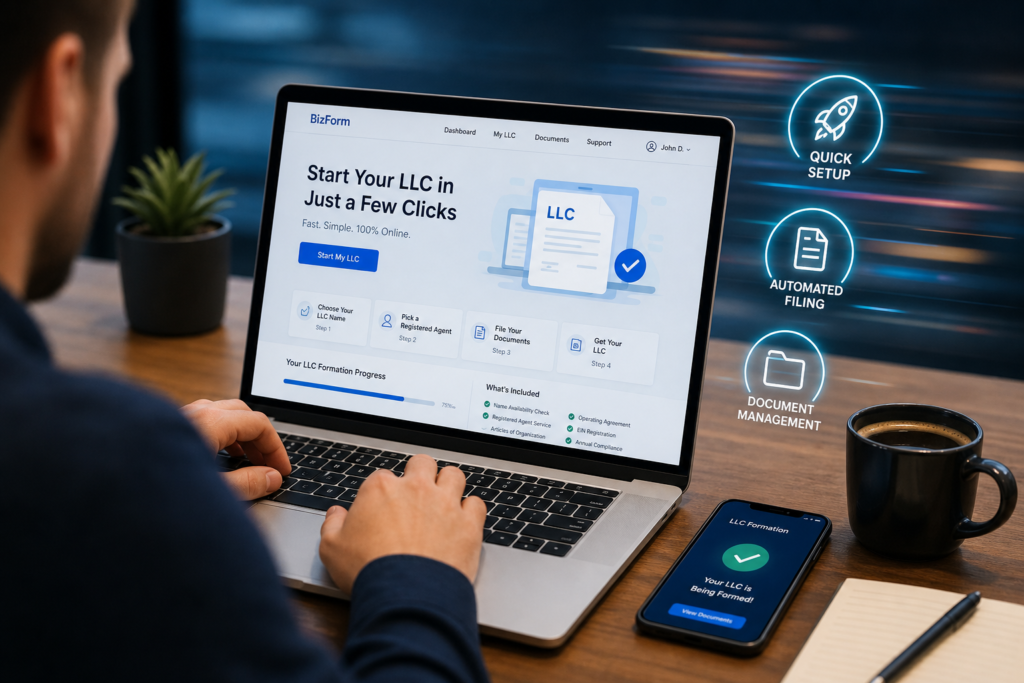
If you are comparing a sole proprietorship and an LLC, the biggest hesitation is usually paperwork.
You may know an LLC is safer, but you do not want to spend hours reading state forms, checking registered agent rules, and wondering whether you filed correctly.
That is exactly where Bizee fits.
Bizee is built for entrepreneurs who want to form a business without making the process harder than it needs to be. Their $0 + state fee entry-level plan makes LLC formation affordable, especially for first-time founders who are watching every dollar.
You also get a free first year of registered agent service when you form through Bizee. That alone can save money compared with paying a separate registered agent provider from day one.
For many small business owners, Bizee removes three common headaches:
- Filing the LLC correctly
- Getting registered agent coverage
- Staying aware of compliance deadlines
Instead of trying to become a legal paperwork expert, you can focus on customers, sales, content, products, and growth.
FAQs About Sole Proprietorship vs. LLC
Is an LLC better than a sole proprietorship?
For most serious businesses, yes. A sole proprietorship is easier to start, but an LLC offers liability protection, stronger credibility, and a cleaner business structure.
If you are only testing a very small, low-risk idea, a sole proprietorship may be enough at first. If you are earning real money or working with clients, an LLC is usually the better long-term choice.
Do I pay more taxes as an LLC than as a sole proprietor?
Not automatically. A single-member LLC is usually taxed like a sole proprietorship by default for federal income tax purposes.
The main benefit of the LLC is legal separation and liability protection. Tax flexibility can become useful later as your profits grow.
Can I switch from a sole proprietorship to an LLC later?
Yes, many business owners start as sole proprietors and form an LLC later.
But waiting too long can leave you personally exposed while your business grows. If you already have clients, contracts, revenue, or business risk, forming an LLC sooner may be safer.
Do I need an LLC before making money?
Not always. You can test some business ideas as a sole proprietor.
Still, forming an LLC before you start taking serious clients, signing contracts, or investing money can give you a cleaner start. It also helps you separate business finances from the beginning.
Is Bizee good for forming an LLC?
Yes, Bizee is a strong choice for beginners who want affordable LLC formation support. Its $0 + state fee entry plan keeps startup costs low, and the included first year of registered agent service adds real value.
It is especially useful if you want help with paperwork instead of filing everything manually through your state website.
Final Thoughts and Next Steps
A sole proprietorship is simple, but simplicity has limits.
If your business is small, casual, and low-risk, you can start there while testing your idea. But once you are dealing with real customers, contracts, revenue, advertising, suppliers, or public brand exposure, an LLC gives you a stronger and safer foundation.
The biggest mistake is waiting until a problem appears before taking your business structure seriously.
Forming an LLC does not need to be expensive or complicated. With Bizee, you can start your LLC for $0 plus your state filing fee, get help with the paperwork, and receive a free first year of registered agent service.
That makes it one of the easiest ways to move from “just getting started” to operating like a real business.
If you are ready to protect your work, build trust, and stop worrying about confusing formation forms, Bizee is a practical place to start today.